
LM324DR2 Quad Operational Amplifier: Key Features and Application Circuits
The LM324DR2 is a classic, industry-standard quad operational amplifier that continues to be a cornerstone of analog design. This low-cost device integrates four independent, high-gain, frequency-compensated op-amps on a single monolithic chip, designed to operate from a single power supply over a wide voltage range. Its versatility and reliability make it an ideal choice for a vast array of analog circuit applications, from transducer amplifiers to DC gain blocks.
Key Features of the LM324DR2
The enduring popularity of the LM324DR2 is attributed to its robust set of features tailored for practical, real-world applications.
Single or Dual Supply Operation: A significant advantage is its ability to function from a single power supply voltage (3V to 32V) or dual supplies (±1.5V to ±16V). This simplifies power rail design, especially in battery-powered devices.
Low Power Consumption: The device features a low supply current drain, which is essentially independent of the supply voltage. This makes it exceptionally well-suited for portable and battery-operated equipment.
Wide Input Common-Mode Voltage Range: It includes ground within its input common-mode voltage range, enabling designers to directly sense signals near ground (Vee) without requiring a negative power rail.
Low Input Bias and Offset Currents: These parameters contribute to higher accuracy in signal processing and measurement applications.
Differential Input Voltage Range Equal to Supply Rail: The inputs can withstand a differential voltage equal to the supply voltage without being damaged, enhancing the amplifier's robustness.
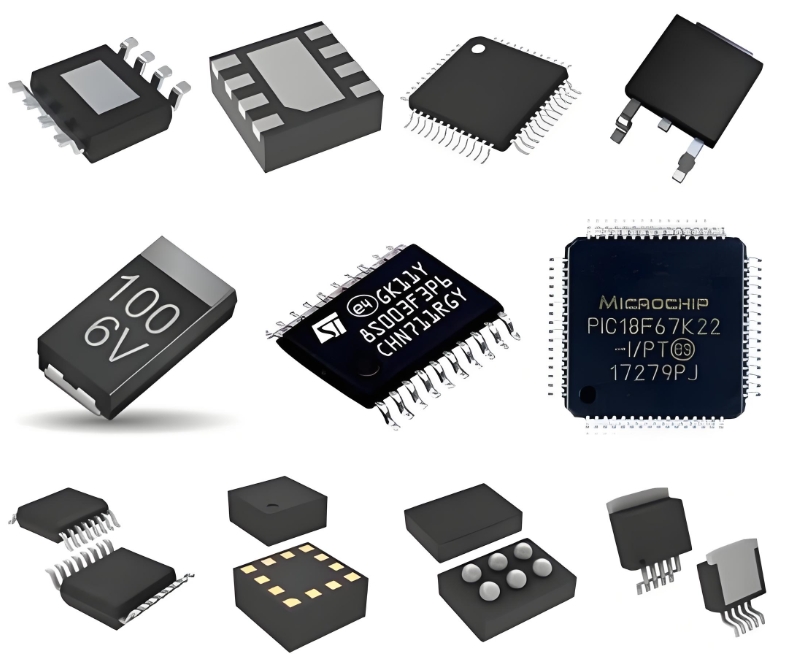
Industry-Standard Package: The LM324DR2 is offered in the common SOIC-14 surface-mount package, ensuring easy integration into modern PCB designs.
Application Circuits
The true strength of the LM324DR2 lies in its application flexibility. Here are two fundamental circuit configurations.
1. Non-Inverting Amplifier
This circuit is used when a high input impedance and a gain greater than unity are required. The input signal is applied to the non-inverting input (+). The closed-loop voltage gain is set by two resistors, R1 and R2, and is given by Av = 1 + (R2 / R1). This configuration provides stability and is perfect for buffering and amplifying sensor signals.
2. Active Low-Pass Filter (First Order)
By incorporating reactive elements (capacitors), the op-amp can be used to build active filters. A simple first-order active low-pass filter can be constructed by adding a capacitor (C1) in parallel with the feedback resistor (R2) in the inverting amplifier configuration. The cutoff frequency (-3dB point) is determined by fc = 1 / (2π R2 C1). This circuit effectively attenuates high-frequency noise while passing lower-frequency signals, which is crucial in data acquisition systems.
The LM324DR2 remains a fundamental component in the electronics engineer's toolkit. Its ability to operate from a single supply, combined with its low power consumption and four-op-amp integration, offers an unparalleled cost-to-performance ratio for a massive spectrum of general-purpose analog tasks, from simple comparators and amplifiers to more complex filters and oscillators.
Keywords:
Operational Amplifier, Single-Supply, Low-Power, Analog Circuits, Active Filter

